About Livres
A practical agenda for listening, validating and designing a pilot
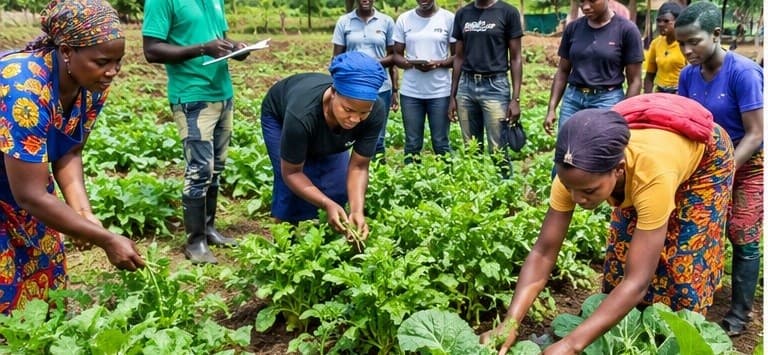
Livres Agriculture & Education Initiative brings technical material, seed know-how and field evidence into Liberia's formal agricultural system. Our current purpose in Liberia is an agricultural survey and field assessment: listening to farmers, extension teams and local institutions; mapping practical constraints across crops and livelihoods; and identifying suitable sites for a small, measurable pilot.
We work in cooperation with the Ministry of Agriculture, Republic of Liberia, guided by one principle: local ownership first, scale only after evidence.
- Listen to farmers, extension teams and local institutions
- Map practical constraints across crops and livelihoods
- Identify suitable sites for a small, measurable pilot
- Align seed, water, soil and market actions with Ministry priorities
Four questions guide every visit
Before any pilot begins, we return to the same four questions in every field, with every farmer and every institution we meet.
What works?
What is missing?
Who owns it?
How to measure?
Liberia-specific priorities, Ministry Corporate Strategic Plan 2025–2030
Food & nutrition security
Increase domestic production; reduce import dependency.
Inclusive agribusiness
Strengthen value chains, agro-processing and jobs.
Research & extension
Expand research, extension, digital and climate-smart agriculture.
Natural resource management
Promote responsible land use, resilience and biodiversity.
Institutional coordination
Improve accountability, performance and multi-stakeholder collaboration.
Source: Liberia Ministry of Agriculture, Corporate Strategic Plan 2025–2030, launched February 2026.
What this means for a pilot
Start with priority value chains and county realities
Site selection follows evidence from the field assessment, not a fixed list decided in advance.
Combine productivity with water, soil and resilience
Yield gains are paired with irrigation and soil-health practices so results hold beyond one season.
Build in women/youth participation from the start
Inclusion is designed into the pilot from day one, not added after the fact.
Use research, extension and the private sector together
No single actor carries the pilot alone; each partner contributes what it does best.
Measure results and publish learning for scale-up
Every stage produces evidence that can be reviewed, questioned and reused.
Digvijaysinh M. Gohil
Independent Agriculture Advisor & Seed Donor, India
Digvijaysinh brings technical material, seed know-how and field evidence gathered across smallholder agriculture contexts, with a focus on turning donated seed and agronomic knowledge into pathways that respect a country's own regulatory system rather than working around it.
His current purpose in Liberia is an agricultural survey and field assessment, prepared for discussion with the Ministry of Agriculture, Republic of Liberia — the first step toward a joint, measurable pilot.
One pilot. One results framework.
A practical division of roles keeps the pilot accountable and scalable. Final roles are agreed with the Ministry and participating institutions.
Government
Policy, coordination, approvals, extension and public systems.
Development Partners
Technical support, finance, capacity and learning.
Private Sector
Inputs, processing, logistics and buyers.
Communities
Land, labor, local knowledge and cooperative ownership.